The Coastal Moonah Woodland located at Narrows Queenscliff Victoria, is a wonderful environment full of twisted and gnarled Moonah trees. Listed as Threatened under the Victorian Government Flora and Fauna Guarantee Act, this vegetation community holds a special place for residents and visitors alike.
In 2020, The Borough of Queenscliffe in partnership with the Bellarine Catchment Network, Country Fire Authority, Working For Victoria and Swan Bay Environment Association embarked on an ambitious program to control the environmental weed Bellarine Pea (Polygala myrtifolia).The Bellarine Pea forms a monoculture under the canopy of the Moonah and along with other invasive species such as Bridal Creeper (Weed of National Significance), reduce the ability for the Moonah to regenerate.
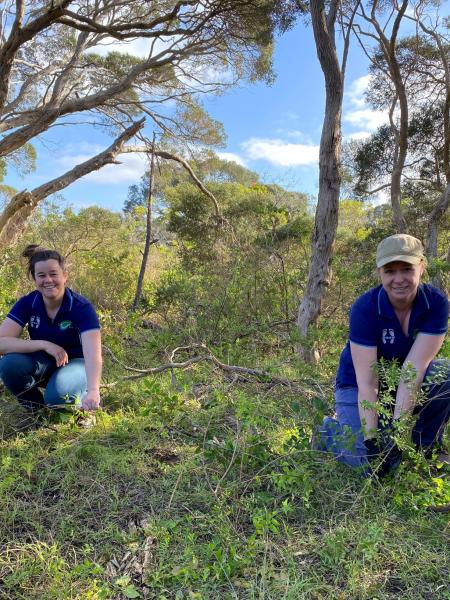 Rebecca and Angie from Bellarine Catchment Network
removing Bellarine Pea
An overall reduction of biodiversity is the result with under-storey and ground cover plants struggling to find space. Pink Fairies, Gnat Orchids, Greenhoods, Coast Swainson-pea and others all struggle in this competitive environment. Reductions of space, light, water and nutrients mean that the little guys have limited opportunity for reproduction in this setting.
The Bellarine Pea in particular has high flammability, forms a dense mass and significantly adds to the fuel loads. This threatens the flora and fauna, adjacent houses and infrastructure. A staggering 168 cubic meters of Bellarine Pea has been removed from the Coastal Moonah Woodland over the past 3 months. This figure is sure to increase throughout 2020.
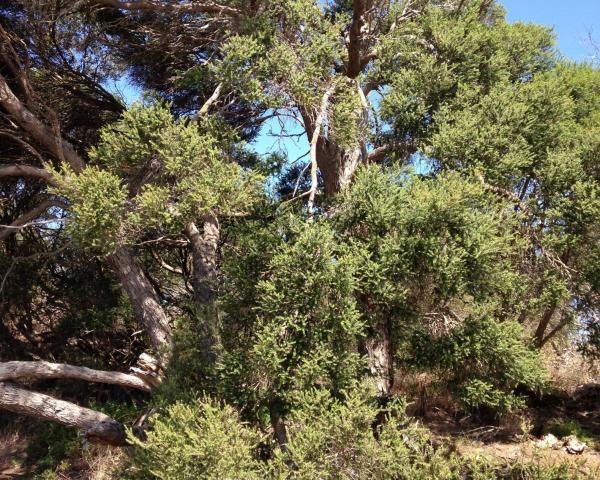 Coastal Moonah (Melaleuca lanceolata)
This innovative and collaborative program has its sights set on turning this around and restoring this ecosystem to its former glory. With the intensive weed removal program, follow up maintenance to ensure weed re-growth is removed and monitoring through quadrants, all aspects are being considered. Six different quadrants and 5 photo point monitoring sites have been set up to monitor weed species and indigenous vegetation recruitment.
This will also measure different control methods which will in turn inform future management and weed control programs for the site. In the next update we will provide more details around the monitoring, methodology and what exciting results are occurring. So stay tuned.
For further details contact Matt Crawley and Lachlan Forbes on info@bcn.org.au
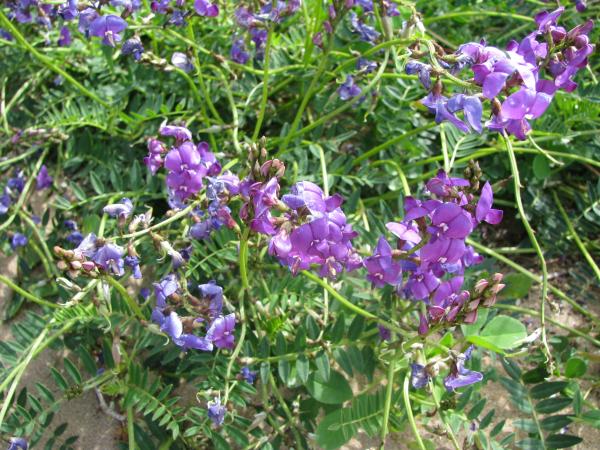 Coast Swainson-pea (Swainsona lessertiifolia)