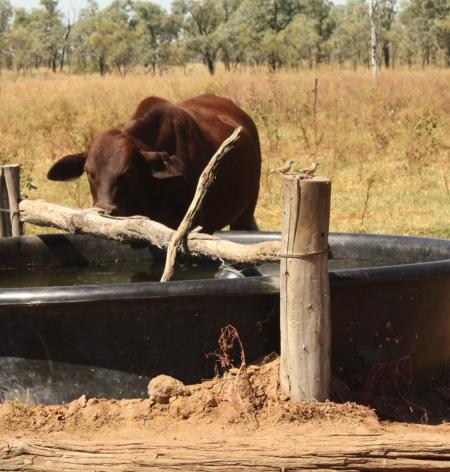
’Tis grand when those extra good things happen along the way in a bigger project. In the middle of Queensland, in spinifex and red sand country straddling a splinter of the Great Dividing Range, as we fought to arrest weeds marching west over and into the inland plains of our ancient internal lake, the newly opened-up ground again became the feeding grounds of the Black-Throated Finch.
When rains come again, the spread of Parthenium and Mother-of-Millions across the Mitchell Grass Downs and into the pristine Channel Country is a Landcarer's nightmare. With RIRDC funding, the Desert Uplands Committee was trialling new treatments (water-based) that were more cost effective and with fewer adverse ecological affects. Past generation chemicals and diesel carriers meant broad application in riparian and ponding areas problematic and costly.
For the project, we had a great weed warrior on the ground, whose passion, drive and attention to detail, and wanting to see that residual pink spray covering all those nasty weeds, was really getting good results. I think it was in part finding, early on, a cow dead in a field of too-healthy parthenium that made him determined to end such pain and suffering of innocent afflicted animals.
Towards the project's end, we held a Field Day, where local landholders/managers, beef producers and Landcarers come to witness the new treatment options and how effective they had been. A hardy few of us had driven up a rough and steep track onto a ridge where the parthenium was literally coming over the Great Divide. With work utes randomly parked back from the stock water trough, we then walked and saw the fading pink vegetative skeletons of the dying weeds. The rains had been sufficient and timely to get a good uptake and kill rates, and small native grasses were recolonising and thickening up well underneath.
We strolled back to the vehicles to allow some approaching cattle to wander in and get a drink from the trough. As the weed warrior/project officer explained further to the group the field methods and results of the spraying, small birds flew in to drink from the trough's edge and float apparatus. With its distinctive markings, and that they were flying in and out of tall nearby silver-leafed ironbarks' and up and down from underneath the dying weeds, I though it may be the Black-Throated Finch. I looked to others who knew more than I, doing the immediate silent nod towards the BTF a'watering. Their small smiles and head pops confirmed it, with a few quick photos for later. The convoy slowly drove back down to the homestead and the Field Day concluded with home-cooked goodies. The next day, I emailed the photos to a BTF knowledge bank and got concurrence (and the property record there made).
Back then, the opening up of the Galilee Minerals Province was more concept than reality, with the BTF merely a threatened species that all of us birdy landholders/carers/producers knew to ‘keep an eye out for' on our properties. So to find the finch quickly taking an advantage of the fresh grass seeds growing under the killed parthenium (and the accompanying close, ‘safe’ water source) for me, as project driver, doubled up the value of this new weed work.
With years of agency and government siloed thinking, policies and programs, rarely can one get such immediate, visual, joyous confirmation of great, layered outcomes from a well-engineered and considered proposal. I was chuffed, more ‘boxes’ were ticked than the final report ever needed.
So do not mock or kill that small bird with its black throat and russet tummy, and maybe think again about its habitat.